Solar + battery
Named after
the battery.
The battery decides how long your power lasts in a brownout, so it names the system. The solar panels are sized to your roof at a free assessment.
For homes and lighter businesses
Pick your size.
These suit houses and lighter businesses alike. A café, a clinic or a small office on a single-phase supply is the same engineering problem as a family home.
15kWh
battery
JANARIX 15
For essentials and one aircon.
By proposal free assessment
6 kW output. Your proposal names the Marstek equipment your house needs, and covers our design, installation and aftercare.
≈22 h of essentials
- 15 kWh battery, 6 kW output
- Quiet, sealed outdoor unit
- Upgrade anytime, nothing replaced
30kWh
battery
JANARIX 30
Whole-home comfort, day and night.
By proposal free assessment
12 kW output. Your proposal names the Marstek equipment your house needs, and covers our design, installation and aftercare.
≈45 h of essentials
- 30 kWh battery, 12 kW output
- Runs several aircons
- Check it from your phone, anywhere
45kWh
battery
JANARIX 45
For big homes and estates.
By proposal free assessment
18 kW output. Your proposal names the Marstek equipment your house needs, and covers our design, installation and aftercare.
≈67 h of essentials
- 45 kWh battery, 18 kW output
- Expands up to 90 kWh
- Also fits resorts and farms
45+kWh
battery
Estates, resorts, farms, anything larger.
The platform keeps going to 90 kWh and 36 kW on the same wiring, six units in parallel. The right size depends on the site, so it is worked out after somebody has stood on it.
Every size can be built two ways.
The sizes above are the standard build, on the Marstek V6000: inverter and battery in one sealed cabinet, and the most storage in the smallest footprint. The Pro build is the same sizes and the same 6 kW output on the Mars I Plus, which carries more panel per inverter, grows in smaller steps and is listed to on-grid standards. They suit different jobs.
You do not have to decide this. We work out which one your house wants at the assessment and write the reason next to it. The difference, if you want it.
Why no panel count here?
Because we don't size from a flyer. We measure your roof and your bills, then size the array to fit, free of charge. Panels, mounting and the install go on the proposal once we have seen the roof.

On the roof
How much of the roof you fill is your call.
Panels, mounting and installation are quoted separately, after somebody has stood on it.
Hours, not watts
How long will it last?
Pick what you want to keep running. Your proposal gets this same comparison, computed from your own appliances.
JANARIX 1515 kWh battery · 6 kW output
≈9.6 h
JANARIX 3030 kWh battery · 12 kW output
≈19 h
JANARIX 4545 kWh battery · 18 kW output
≈29 h
Estimates at 90% usable battery. In the daytime, solar recharges the battery while your home keeps running, which is why the figure that matters is whether you reach sunrise, not how many hours in total.
What is included
What a system is made of.
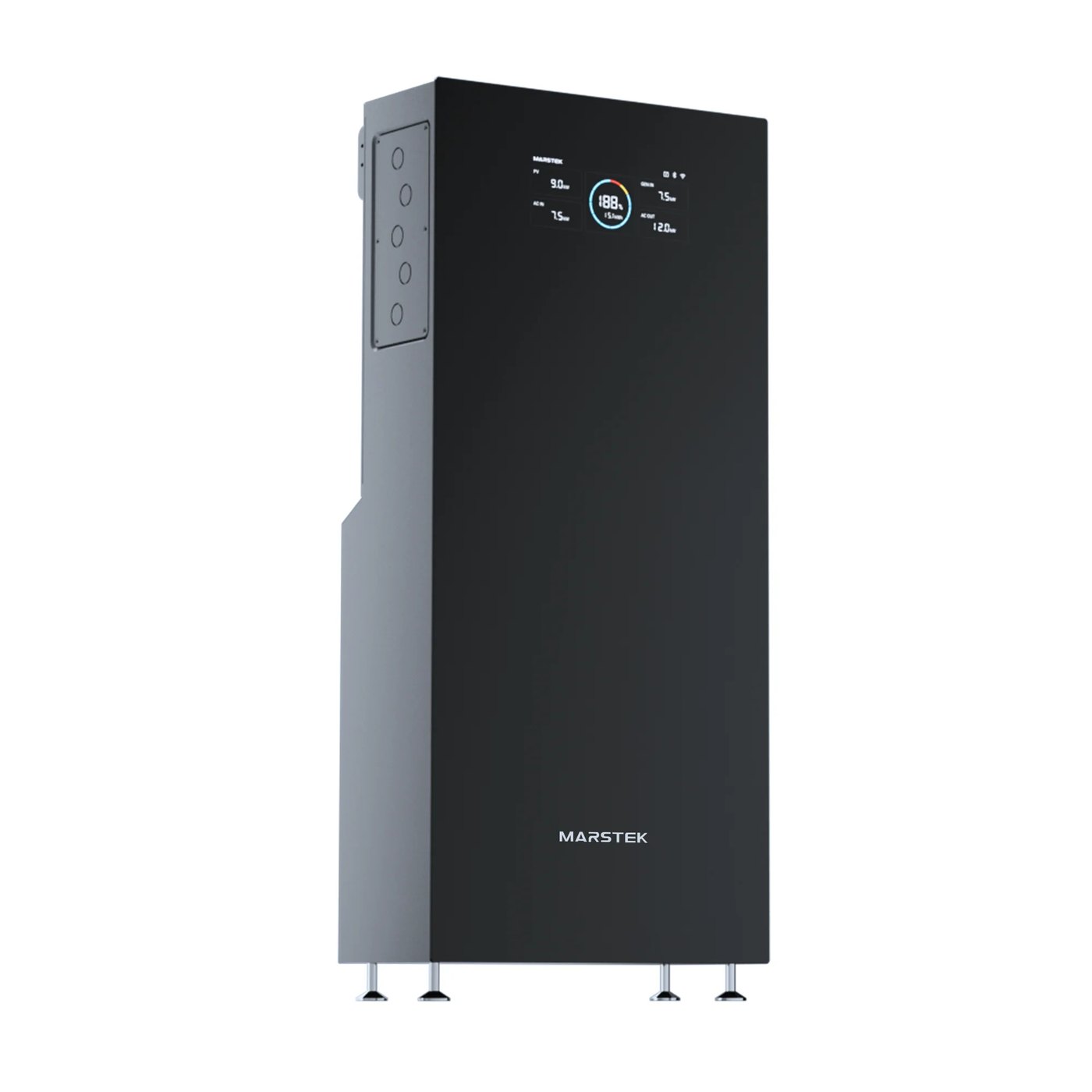
Every system is built on one Marstek cabinet holding the inverter and the battery. The equipment comes from Marstek. The sizing, the installation and everything after it come from us, and both halves are set out in your proposal.
- Your Marstek platform, V6000 or Mars I Plus, with the exact model named on your proposal
- Rain-proof to IP65, quiet, and built to sit outdoors
- Phone app, check your home from anywhere
- Designed by an engineer, fitted by skilled installers
- As-built drawings and specifications, so any inspection has its papers
- A replacement warranty and the upgrade path, in writing
Under the lid
One platform, or the other.
Every size above can be built two ways. The standard build uses the Marstek V6000, the Pro build uses the Mars I Plus. Same sizes, same names, different hardware underneath, and each one is better at a different job.
Standard build
Marstek V6000
One sealed cabinet holding the inverter and the battery. Nothing to stack, nothing with a fan in it, and the most storage in the smallest footprint.
- Most battery per cabinet. 15.07 kWh in a single unit
- Fanless and sealed to IP65. Fewer things that can fail
- Quick to deploy. One box, one position, one connection
- 6 kW out, 12 kW peak, room for 9 kW of panels
- Six run in parallel, to 90 kWh
Pro build
Marstek Mars I Plus
A hybrid inverter on the wall with battery modules stacked beside it. The same 6 kW of output, and a heavier, better specified piece of equipment: a 35 kg wall unit, sealed to IP65, running under 30 dB.
- Net metering ready. If export opens up here, no hardware changes
- Switches in under 10 ms. Half the standard build's figure
- 10.1 inch screen on the unit. The state of the system without reaching for a phone
- Modular. Grows 5.12 kWh at a time, to 30.72 on one inverter
- Two MPPT trackers. Up to 12 kW of panel, and two roof faces tracked separately
- 97.6% peak efficiency. Less of what the roof makes lost on the way through
- A rated generator input. Both platforms charge from a genset; this one publishes the figure it will take
We size for what your house will actually use
You will see payback figures built on selling surplus solar back to the grid. Net metering is not available through the cooperatives here at the moment, so we leave it out of the arithmetic entirely.
What we size for instead is simple: every kilowatt-hour your roof makes is worth whatever you would otherwise have paid for it, the moment your house uses it — straight away, or through the battery that evening. So we build the system that puts as much of it to work as possible.
So which one goes on your house
The standard build, if
- You want the most storage your budget will buy
- The job is backup and self-supply, and export is not part of the plan
- You are off-grid, or the supply is unreliable enough that it may as well be
- You would rather have one sealed box than a wall of components
The Pro build, if
- You want to be ready for net metering before it arrives
- You would rather grow 5 kWh at a time than 15
- A generator is staying in the design
- You want the longer replacement cover and the faster switchover
- You would rather have the heavier, higher specified hardware on the wall
Sized separately, and quoted beside the standard build so you can see both before you choose.
Past 45 kWh this stops being a choice between two boxes and becomes an engineered system, which we handle separately. See how that works. Either way we pick the platform at the assessment and write the reason on page one of your proposal.
Start small, grow later
How a system grows.
Both builds are designed to be added to, and nothing inside the house is rewired to do it. What differs is the size of the step.
Two ways to build the same size. Pick either one to see how it grows.
JANARIX 15
15.07 kWh · 6 kW out
One sealed cabinet. Inverter and battery together, ready to run.
JANARIX 30
30.14 kWh · 12 kW out
A second whole unit beside the first. The battery doubles and so does the output, because each cabinet brings its own 6 kW inverter.
JANARIX 45
45.22 kWh · 18 kW out
The biggest standard size. Three cabinets, three inverters, working as one system on one app.
Four units
60.29 kWh · 24 kW out
Past the standard sizes. Quoted per site from here, because the panel and the supply have to be looked at.
Five units
75.36 kWh · 30 kW out
Enough output for a small commercial load, with the hours to match.
Six units
90.43 kWh · 36 kW out
The ceiling on the platform: six cabinets in parallel, about 90 kWh and 36 kW.
Every step is a whole cabinet. Each one brings its own inverter, so the hours and the output rise together and you are never short of one while paying for the other. Six units is the ceiling, at 90 kWh and 36 kW.
One module
5.12 kWh · 6 kW out
The inverter goes on the wall once. This is the smallest way in.
Two modules
10.24 kWh · 6 kW out
A module is stacked under the first. Nothing on the wall changes.
Three modules
15.36 kWh · 6 kW out
About the storage of one V6000, on an inverter that takes 12 kW of panel.
Four modules
20.48 kWh · 6 kW out
The size that falls between V6000 steps, bought exactly.
Five modules
25.60 kWh · 6 kW out
One short of the ceiling, and still the one inverter on the wall.
Six modules
30.72 kWh · 6 kW out
Six modules is the stack one inverter takes. For more, the next step is power.
A second inverter
61.44 kWh · 12 kW out
When the house wants more appliances running at once, a second inverter goes up beside the first with its own stack. Four is the ceiling, at 24 kW.
Two different steps. More hours is a module on the stack, and the output stays at 6 kW. More appliances at once is a second inverter beside the first, up to four of them and 24 kW. You buy each one only when you need it.


Ways to pay
Pay the way that fits you.
Your rate and your approval come from the bank. What we do is get the paperwork right the first time, so you are not sent away and back again.
Pay directly
The straightforward route. Your price is fixed in the proposal and does not move on installation day.
Bank or home loan
Home-equity, solar or personal loans usually carry the lowest rates on bigger systems. You arrange this with your bank, not with us.
Business and SME loans
Equipment financing, where backup units count as movable equipment. Again, arranged with your lender.
GSIS and Pag-IBIG
Members can often borrow against their contributions. Worth asking your branch what you are eligible for.
What we actually do
We prepare the papers. Itemised quotation, equipment specifications, and whatever else your lender asks to see. Tell us who you are applying to and we will put it in the format they want.
Coming later
Janarix Reserba, our staged payment plan, and 0% instalments on participating cards. Neither is open yet. When they are, they will be on this page with their terms.
Before you ask
Common questions.
The inverter and the battery, the two parts that do not change from house to house. Solar panels, mounting and installation are sized after we have seen your roof, because how much of it you fill is your call and not ours.
It all lands in one itemised written proposal after a free assessment, and what is on it does not move on installation day.
However many your roof, your orientation and your actual consumption call for. We measure all three at the assessment and size the array to fit. Anyone who quotes a panel count before seeing the roof is guessing.
Because we would rather install one platform properly than six badly. Marstek develops its own cells and electronics, makes them in its own factories, and sells most of its home batteries in Europe, where the grid and safety standards are among the strictest anywhere. Clearing those year after year is the part we were buying.
Within that platform there are two builds, and every size can be built either way. The standard build uses the V6000 and is what the sizes on this page describe. The Pro build uses the Mars I Plus, which gives the same 6 kW of output to a higher specification and is quoted on its own terms. Which one suits your house depends on the roof, the load and whether export is in your plans, so we work it out at the assessment and write the reason next to it. The difference is set out above if you want to read it first.
Yes. A café, a clinic or a small office on a single-phase supply is the same engineering problem as a family home. Three-phase sites and large operations go through the engineered route instead.
The same platform runs six units in parallel on the same wiring, up to 90 kWh and 36 kW. The right size depends on the site, so it is worked out after a visit.
The first step
Start with a short talk.
30 minutes at your home or office. No pressure and nothing to sign. You leave with one thing: a free engineering assessment, scheduled.